How Often Should You Change Your Kitchen Garbage?
Transparency Note: We independently select these products based on research and user reviews. If you buy something through our links, we may earn a commission.
In a house with four daughters and a high-performance meal-prep schedule, the kitchen garbage isn't just a bin, it’s a biological waste station. I look at the garbage area as a high-risk zone for "Infrastructure Contamination."
If left too long, organic waste begins a process of anaerobic decomposition, releasing moisture and VOCs (volatile organic compounds) that can permeate your cabinetry and affect your kitchen's air quality. To maintain a Sustainable Sanctuary, we need a strict extraction schedule. Most people wait until the bag is full to take out the trash, but we don't measure garbage by volume; we measure it by Bio-Load.
1. The "24-Hour Extraction" Rule
In my years on job sites, I’ve seen what "leachate" (the technical term for trash juice) does to the inside of a wooden cabinet. It is acidic, corrosive, and smells like failure.
The Rule: Regardless of how full the bag is, the kitchen garbage should be removed every 24 hours.
The Physics of Decay: Biological decay begins almost immediately. After 24 hours, the moisture levels inside the bag rise, creating a breeding ground for fruit flies and bacteria that off-gas into your kitchen "sanctuary." By pulling the bag daily, you reset the clock on indoor air pollution.
2. Managing the "Wet vs. Dry" Infrastructure
The secret to a high-performance kitchen is separating your waste streams. If you remove the "Wet" waste, your "Dry" trash can wait much longer.
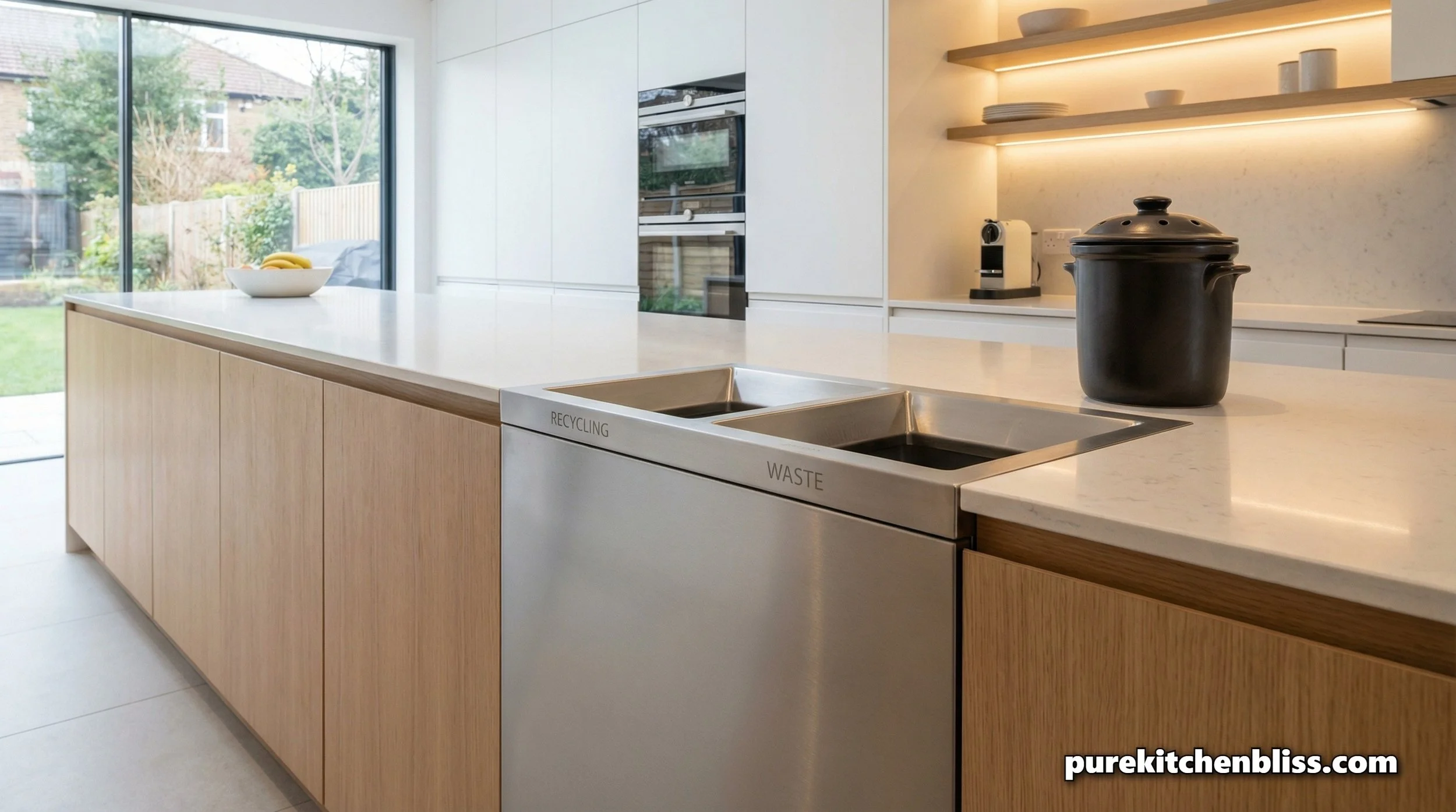
The Compost Pivot: 90% of kitchen odors come from organic food scraps. By using a dedicated, countertop compost bin or a freezer-compost system, you remove the "stink" from your main garbage.
The Benefit: With organics removed, your main trash bag is mostly "dry" packaging. This can be changed every 2–3 days, reducing your plastic bag consumption and supporting your Organization & Zero-Waste goals.
BUILDER TIP: THE CABINET SHIELD
If your trash bin is hidden inside a pull-out cabinet, you must ensure the area is ventilated. Trapped trash odors can soak into the unfinished porous wood of the cabinet's interior, leading to a permanent "musty" smell that no amount of cleaning can remove.
3. The "Deep Sump" Clean (Weekly Ritual)
Even with the best "leak-proof" bags, microscopic failures happen. Over time, the bottom of your trash bin becomes a "bio-film" reservoir.
The Protocol: During your Sunday Night Countertop Reset, take 5 minutes to wash the actual bin.
The Non-Toxic Mix: Spray the interior with your Non-Toxic Kitchen Degreaser and wipe it dry.
The Pro Hack: Sprinkle a tablespoon of baking soda at the bottom of the bin (under the bag) to act as a permanent "Vapor-Phase" neutralizer for any lingering odors.
Waste Management Frequency Matrix
| Waste Type | Extraction Frequency | The "Pure" Protocol |
|---|---|---|
| Standard Garbage | Every 24 Hours | Remove nightly to reset air quality. |
| Organic/Compost | After Every Meal | Use a charcoal-filtered countertop bin. |
| Dry Recycling | Every 3–4 Days | Rinse containers to prevent "sugar-rot" odors. |
| "Heavy Hits" | Immediate | Raw meat/fish packaging goes straight to the curb. |
4. Dealing with "Heavy Hits" (The Immediate Out)
In the trades, we "clear the site" after every major phase. You should do the same in your kitchen. Some items should never spend the night in your sanctuary:
Raw Protein Packaging: Anything that held meat or fish goes out immediately. These items harbor pathogens that multiply exponentially in the heat of a kitchen bin.
The "Coffee" Effect: As we noted in 5 Uses for Coffee in Your Kitchen, grounds are great for odors, but wet grounds in a warm trash can will grow mold in under 12 hours.

The Waste Mastery Toolkit
To maintain a pure kitchen, you need the right "containment" infrastructure. We’ve curated the best odor-locking bins for your high-performance home:
The Station: Dual-Compartment Step Trash Can (Stainless Steel)
The Filter: Countertop Compost Bin with Charcoal Filter
The Barrier: Eco-Friendly, High-Density Biodegradable Bags
Conclusion: Purity in the Extraction
Changing the garbage isn't just a chore; it’s a structural maintenance task. By following the 24-hour rule and separating your organics, you protect your cabinetry, your air quality, and the blissful vibe of your kitchen.
Read More: