The Rise of Invisible Induction: Cooking Under Stone Surfaces
In the evolution of the high-performance sanctuary, the ultimate goal has always been the seamless integration of technology and aesthetics. For years, the sleek glass surface of a standard induction cooktop was considered the peak of minimalism. However, in 2026, the "Builder" community has pushed the boundaries further with Invisible Induction, a system where the cooking elements are mounted entirely beneath the countertop slab.
This technology allows your kitchen island to function as a seamless piece of stone for prep, dining, and entertaining, only revealing its culinary capabilities when a magnetic pan is placed on the surface. But "Invisible Induction" is not a simple plug-and-play upgrade; it is a complex intersection of physics, material science, and precision fabrication. To implement this infrastructure, one must understand how magnetic fields interact with stone and the thermal management required to prevent slab failure.
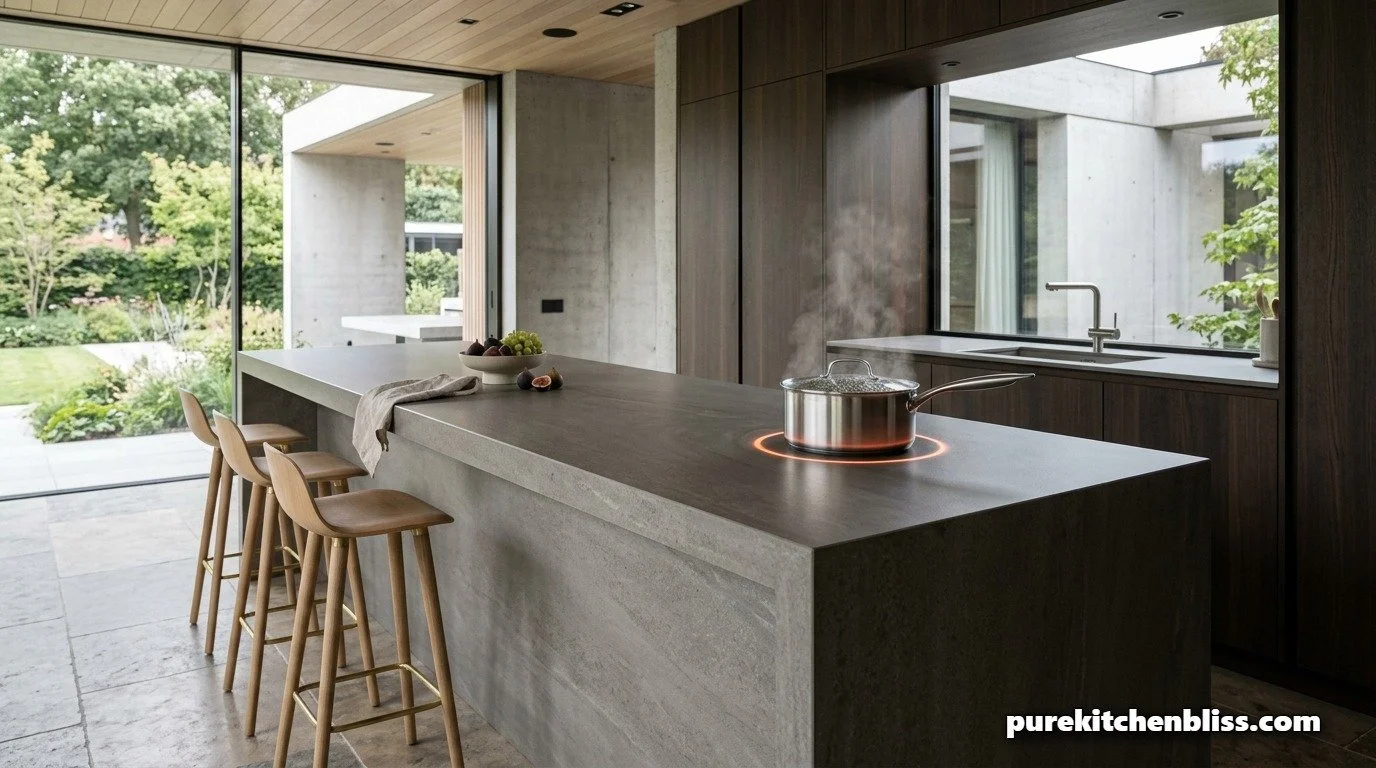
1. The Physics of Through-Slab Cooking
Standard induction relies on a copper coil beneath a thin sheet of glass. Invisible induction uses the same electromagnetic principle but requires a much more powerful coil to project the magnetic field through a 12mm to 20mm thick stone slab.
Magnetic Penetration: The magnetic field passes through the stone without heating the stone itself. Instead, it excites the iron molecules in your cookware, generating heat directly in the pan.
Thermal Decoupling: The primary challenge isn't the magnetic field; it's the residual heat from the pan. Because the pan sits directly on the stone, the heat can transfer back into the slab. High-performance systems use specialized "thermal spacers" or silicon mats to create a microscopic air gap, preventing the stone from reaching critical temperatures that could lead to thermal shock.
2. Material Compatibility: Sintered Stone vs. Natural Granite
Not all countertops can handle the rigors of invisible induction. Choosing the wrong material for this infrastructure is a recipe for a catastrophic crack.
Sintered Stone & Porcelain: These are the gold standards for invisible induction. Materials like Dekton or TPB Tech are manufactured under extreme pressure and heat, making them almost entirely immune to thermal expansion. They can withstand the concentrated heat of a pan without the risk of cracking.
Granite: While some high-density granites can work, they often contain internal fissures or "veins" that can expand at different rates when heated, leading to structural failure.
Quartz Warning: As we noted in our Ammonia Myth guide, quartz is bound together by resins. These resins have a much lower heat tolerance than stone or porcelain. Using invisible induction under standard quartz can cause the resin to scorch, yellow, or melt.
3. The "Workstation Island" Infrastructure
When you remove the visible cooktop, you transform the Preparation Zone. The island is no longer divided between "cooking" and "prep."
Seamless Cleaning: Without a glass-to-stone transition or a metal frame, there are no "crumb-catchers." The entire surface can be wiped down in seconds.
Safety: Because the stone itself does not get hot (other than residual heat from the pan), the risk of accidental burns is significantly reduced. This makes the kitchen a safer environment for families with young children, a key consideration for non-toxic kitchen safety [INTERNAL LINK: ].
4. Technical Comparison: Invisible vs. Surface Induction
| Feature | Standard Induction | Invisible Induction |
|---|---|---|
| Surface Material | Ceramic Glass | Sintered Stone / Porcelain |
| Boil Time | Ultra-Fast | Slightly Slower (due to slab thickness) |
| Visual Impact | Modern/Sleek | Zero Visibility (Hidden) |
| Fabrication Cost | Standard | High (Requires precision CNC) |
5. Installation: The Builder’s Perspective
Installing invisible induction is an exercise in extreme precision. It is not something a standard appliance installer can handle; it requires a partnership between an electrician and a master stone fabricator.
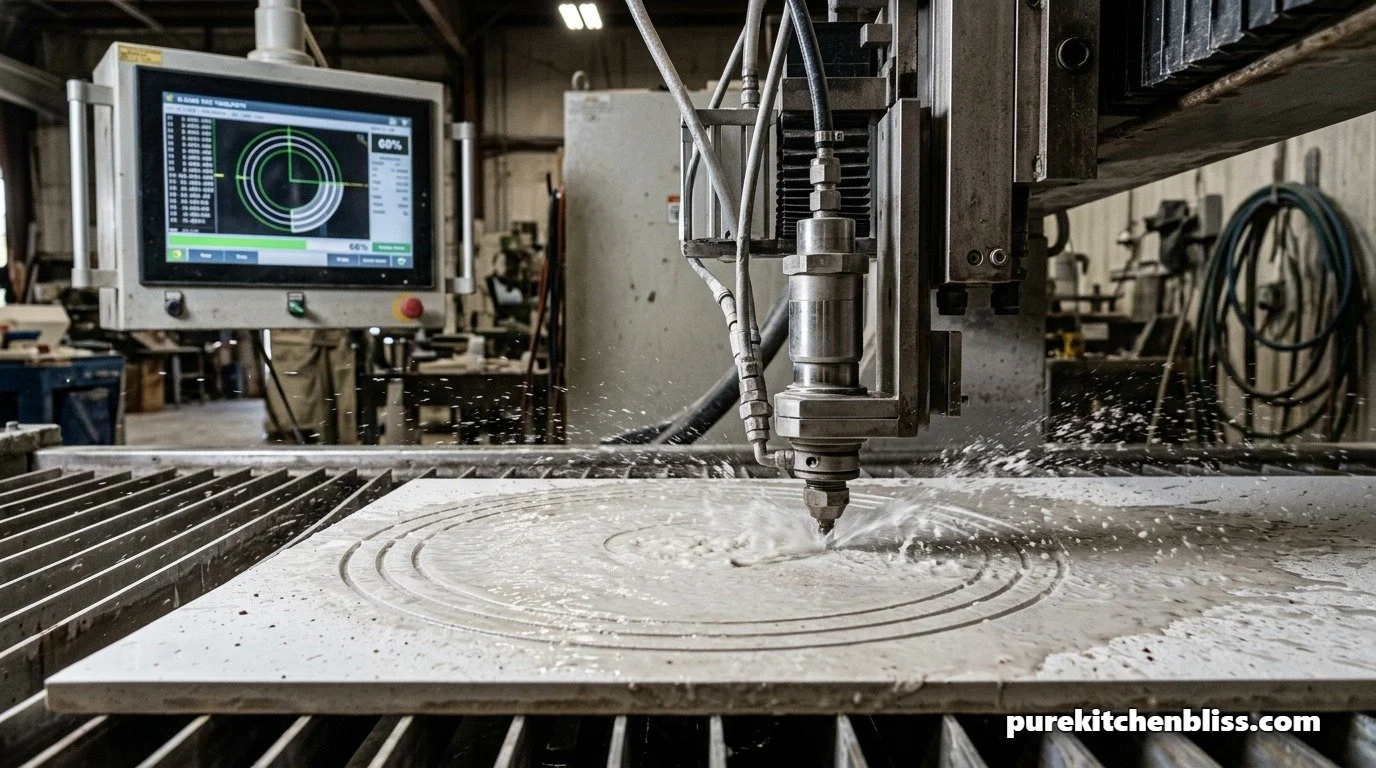
The Underside Mill: The fabricator must use a CNC machine (as shown in Image 2) to "thin out" the stone from the underside, leaving only a few millimeters of material where the coils will sit. This ensures the magnetic field is strong enough to reach the pan.
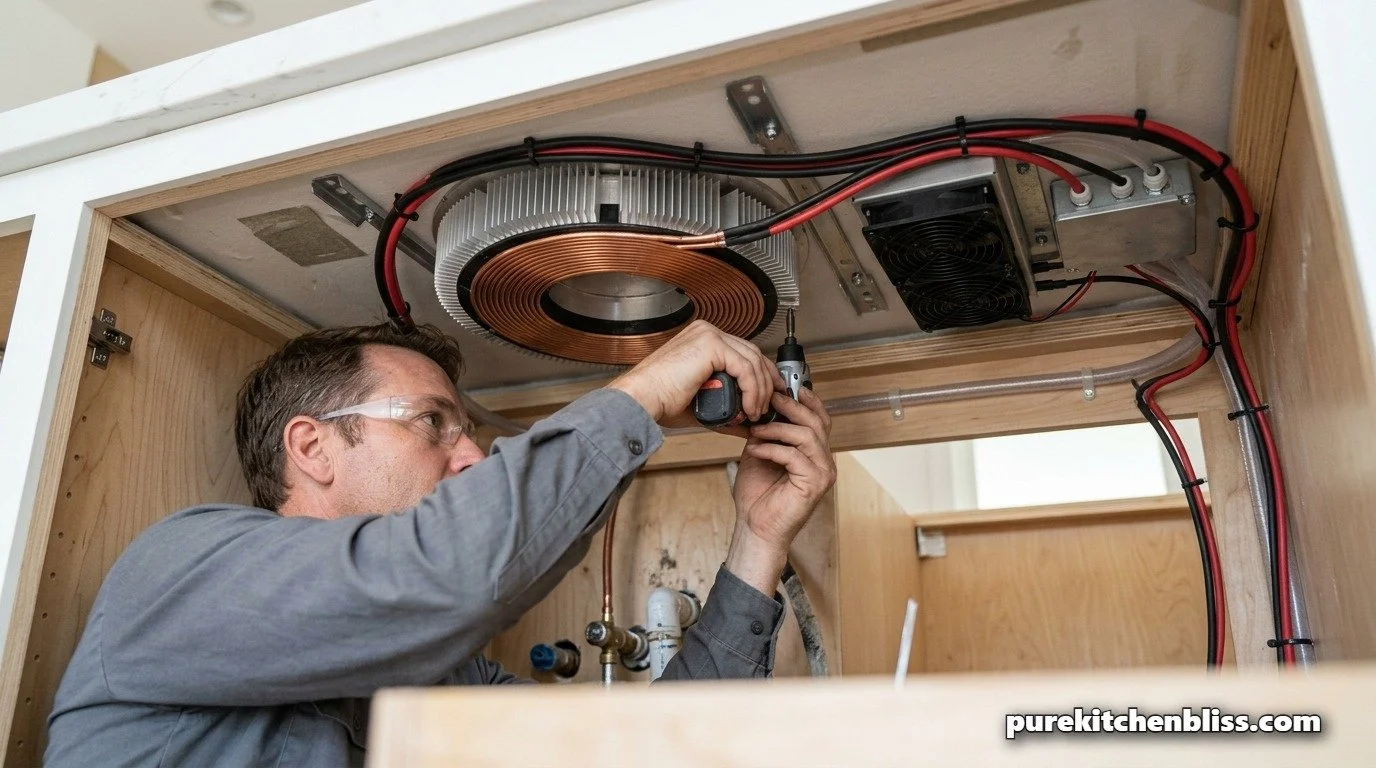
Ventilation Infrastructure: Because the coils are enclosed within the cabinetry (as shown in Image 3), they generate significant heat. A high-performance installation must include integrated intake and exhaust fans within the cabinet base to prevent the electronics from overheating and shutting down.
Control Systems: Without physical knobs or a glass touch-panel, controls are often integrated into the front edge of the countertop or operated via a remote-control puck or smartphone app.
6. Maintenance and Longevity
Maintaining an invisible induction surface is identical to maintaining the rest of your stone. Unlike glass cooktops that can show "burned-on" rings, the stone surface remains relatively cool. If any "metal transfer" occurs from sliding a pan, it can be removed with the same mild abrasives and methods used for the rest of the island.
Conclusion: The End of the Appliance Era Invisible induction represents a shift from "Appliances sitting in a kitchen" to "The kitchen is the appliance." By merging the cooking surface with the stone infrastructure, we create a space that is more versatile, more hygienic, and visually silent. For the homeowner seeking the pinnacle of 2026 kitchen design, the future is invisible.
Next Up: Learn how to manage your high-performance prep area with our guide on The Anatomy of a Workstation Sink.