Transparency Note: We independently select these products based on research and user reviews. If you buy something through our links, we may earn a commission.
Sharp 90-degree island corners are quietly disappearing from new kitchen designs in favor of curved profiles, pill shapes, and rounded waterfall edges. Design coverage tends to stop at the finished photo, but as a carpenter, what actually interests me is what changes behind the scenes to make that curve happen, the fabrication process, the material choice, and the real cost premium that most articles gloss over entirely.
Here's the honest version, why the trend is genuinely happening rather than just a passing look, what curved construction actually requires from a cabinet shop and stone fabricator, and where a curve meaningfully improves a kitchen versus where it's mostly there to look good in photos.
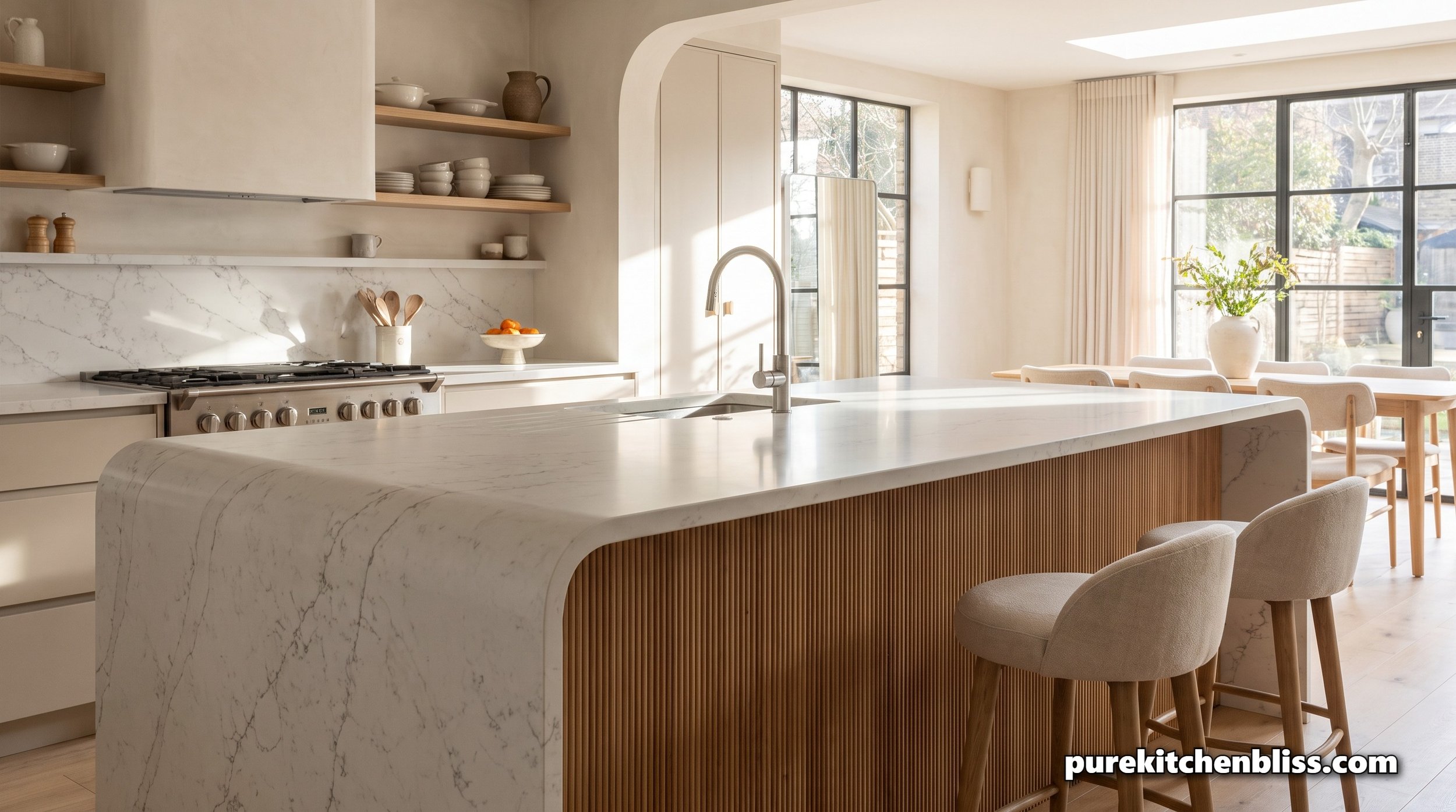
Why the trend is genuinely happening, not just a passing look
The shift away from hard rectangular islands is driven by two related things, traffic flow and how the island functions as a piece of furniture rather than just a work surface. In an open-plan kitchen, a sharp-cornered island creates hard stopping points that people naturally route around, while a rounded or curved edge softens that path and makes the space feel less blocky, particularly on the seating side where people are moving in and out of stools regularly. Designers are also increasingly treating the island as a standalone architectural statement, closer to a piece of furniture than a fixed utility surface, which naturally pushes toward more sculptural, less boxy shapes.
There's a practical safety angle too, particularly relevant with kids in the house. A rounded corner eliminates the specific hard, low-hanging edge that a hip or a small child's head can catch on a rectangular island's corner, which is a real, if modest, safety improvement over a standard 90-degree edge.
What curved construction actually requires
This is the part that separates a genuine curved island from a design photo, and it's where the real cost and complexity live. A curved cabinet box isn't a standard rectangular carcass with a curved countertop set on top, the cabinet panels themselves need to be shaped or built up to follow the arc, which means custom fabrication rather than pulling from a stock cabinet line. That detailing has to be worked out early in the design process, since it affects circulation, seating placement, lighting position, and even flooring direction around the island, not just the island itself.
The countertop side carries its own complexity. Curved stone fabrication requires specialized cutting tools and more time on the fabricator's end than a straight edge does. Material choice matters here more than people realize, engineered quartz has meaningfully higher flexural strength than natural granite, which makes it a more forgiving material to shape into a curve without the risk of cracking during fabrication that a more brittle natural stone carries. That's part of why quartz remains the dominant material for curved and waterfall island work even as natural stone stays popular elsewhere in a kitchen.
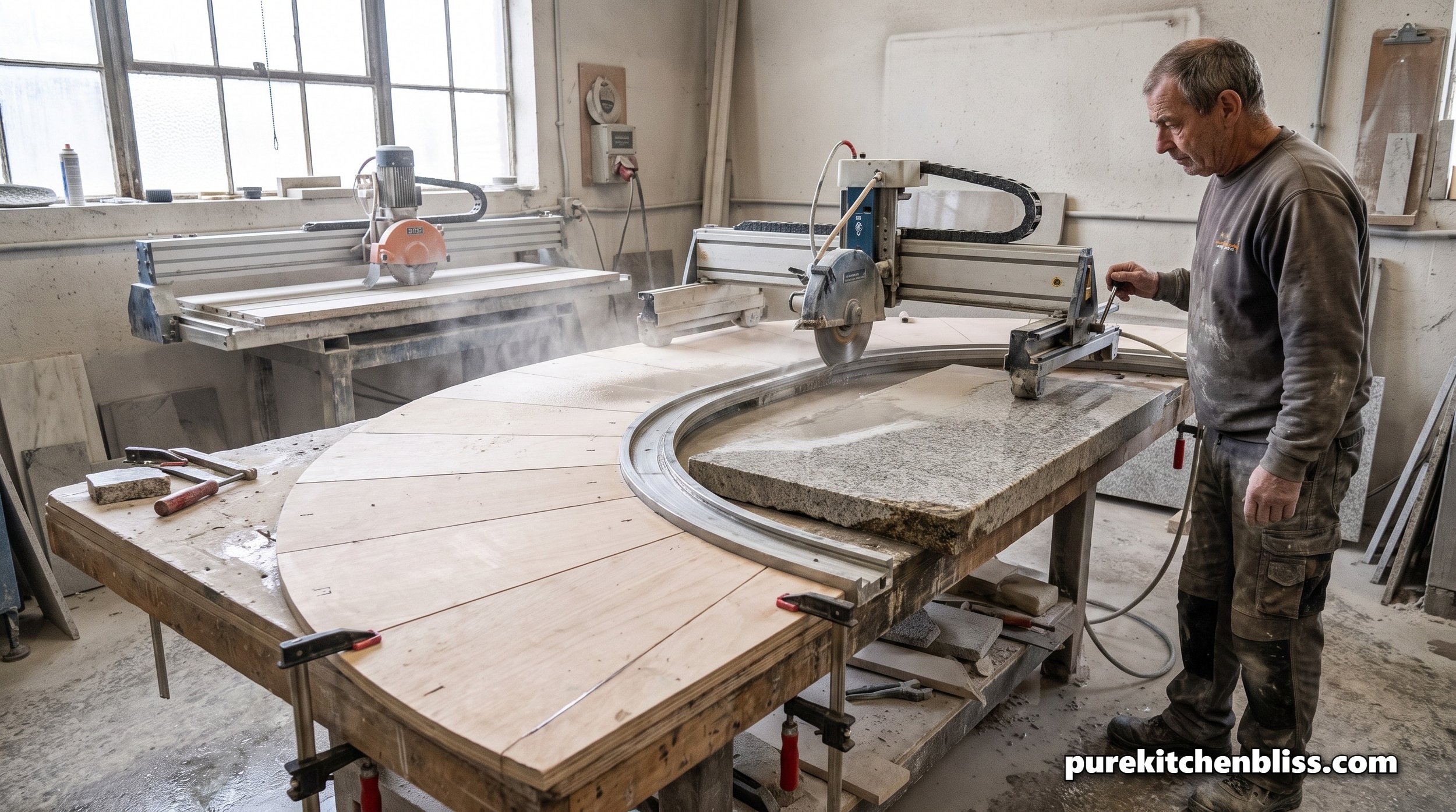
The real cost premium, not the design-magazine number
A standard built-in island with a stock cabinet box and a mid-range quartz top typically runs somewhere in the $3,000 to $7,000 range fully installed, with a national average closer to $4,800 according to recent Angi data. Curved fabrication adds a genuine premium on top of that baseline, roughly 15 to 20 percent more on materials and fabrication alone, driven by the custom cabinet shaping and the specialized stone cutting work described above. On the lower end, a basic curved island with a laminate surface can start around $4,500, while a fully custom curved island with a waterfall edge and premium stone can run $12,000 to $15,000 or more.
That range matters for planning purposes, a curve isn't a small upcharge you add at the last minute, it's a decision that shifts the whole project's budget and timeline, since custom cabinet and stone fabrication both take longer than pulling from stock inventory.
Where a curve genuinely helps versus where it's mostly aesthetic
Curves earn their keep most clearly in two situations, smaller kitchens where a large, blocky rectangular island disrupts flow and makes the space feel tighter, and open-plan layouts where the island sits in a high-traffic path between rooms. In both cases, a rounded or curved profile genuinely improves how people move through the space, not just how it photographs. Some designers are pushing even further in small kitchens, replacing a built-in island entirely with a freestanding table-like piece, which sidesteps the curved fabrication question altogether while solving the same flow problem, and tends to cost meaningfully less since it skips built-in cabinetry and plumbing connections entirely.
Where a full curve is more about the statement than the function is a large, already-open kitchen with plenty of clearance around a standard rectangular island. In that situation, a full sweeping arc is a genuine design choice rather than a flow necessity, worth doing if the aesthetic and budget both support it, but not something that solves a real spatial problem the way it does in a tighter kitchen.
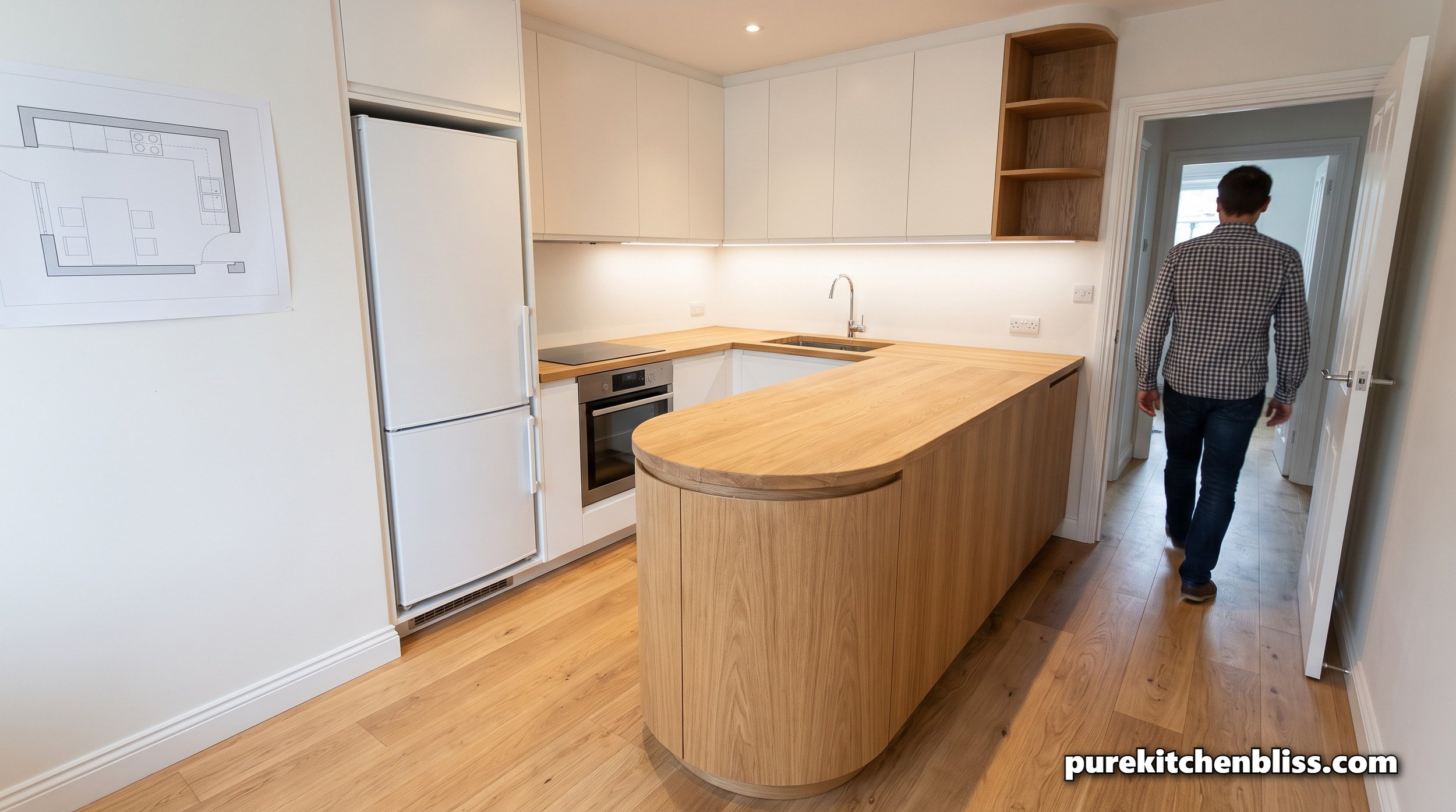
The waterfall pairing and the warm-wood-meets-stone look
Waterfall countertops, where the stone slab wraps down the side of the island to the floor, remain heavily paired with curved and rounded islands in 2026 designs. What's changed is the material pairing itself, the dominant look has shifted away from white veined quartz on a white base toward warm-toned wood islands paired with veined or warm-leaning stone on top, a deliberate cool-stone-meets-warm-wood contrast that's become the defining look of the current design moment. If you're already thinking through cabinet finish choices for a project like this, our kitchen color trends guide covers the broader palette shift this pairing sits within.
What to ask before committing to a curved build
If you're seriously considering a curved island, get the cabinet shop and stone fabricator talking to each other early, ideally before either one starts building anything, since a mismatch between the cabinet radius and the stone template is a genuinely expensive mistake to correct after the fact. Ask specifically about lead time, custom curved cabinet boxes and stone fabrication both take longer than stock work, and a curved island project should be budgeted with extra weeks built in compared to a standard rectangular build. If a full curve feels like more commitment than you want, a partial approach, rounded corners on an otherwise rectangular island, gets some of the traffic-flow and safety benefit without the full cost and lead-time premium of a complete arc.
If your kitchen already has a standard rectangular island and lighting is part of a broader update, our under-cabinet lighting guide and our open shelving versus closed cabinets guide both cover related structural and design decisions worth thinking through at the same time as an island update.
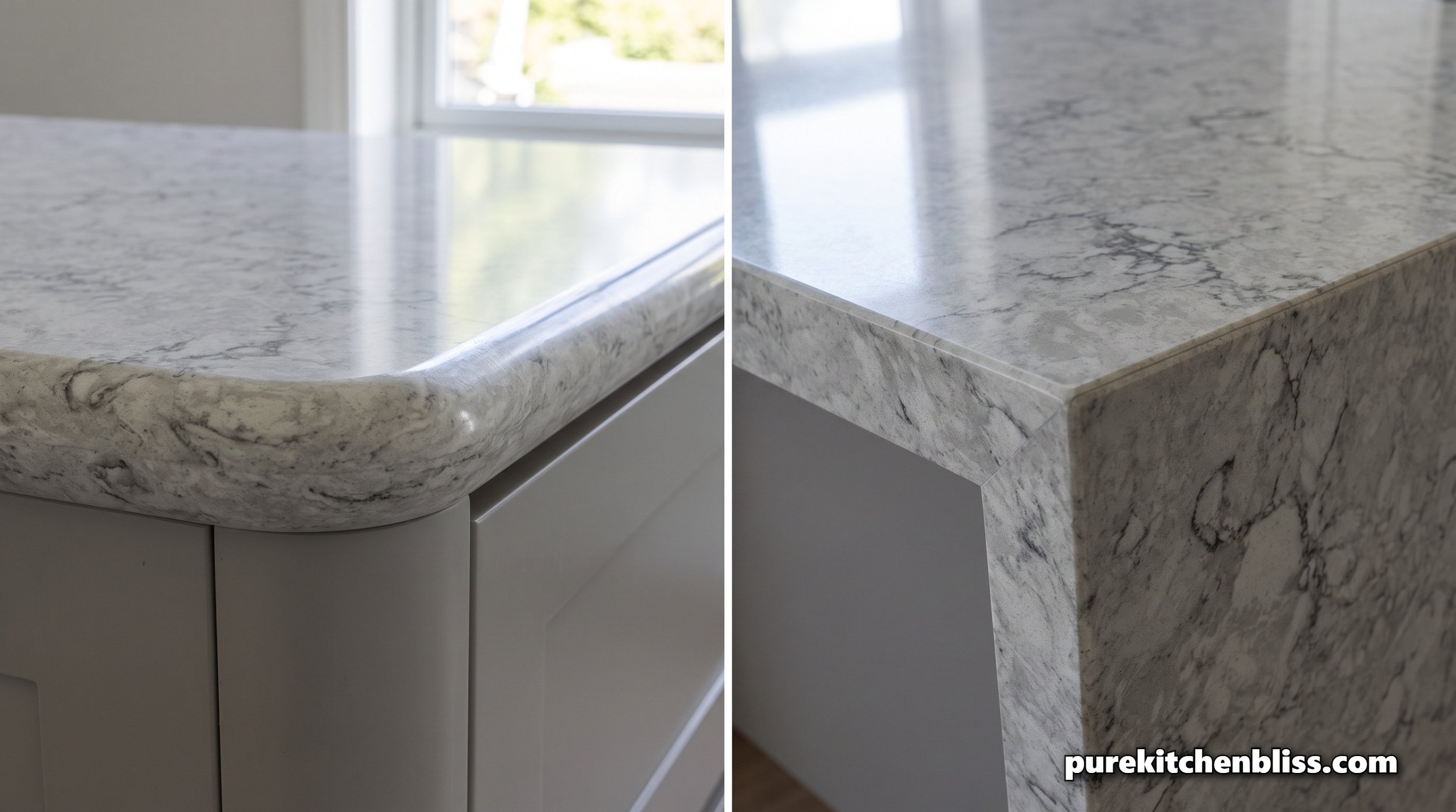
What's worth adding without a full rebuild
If a full curved island isn't in the budget right now, a few smaller changes still improve safety and function on an existing rectangular island. Rounded corner guards soften the exact hard edge that makes sharp island corners a safety concern with young kids, a genuinely useful interim step if a full rebuild isn't happening soon. A proper stone cleaner and sealer kit keeps whatever countertop you have looking its best regardless of shape. And if you're updating the island area at all, LED strip lighting along the island's base or underside adds a real visual upgrade that pairs well with either a curved or standard rectangular design.
| Island type | Typical cost | Best for |
|---|---|---|
| Standard rectangular, stock cabinets | $3,000-$7,000 (avg ~$4,800) | Budget-conscious builds, larger open kitchens |
| Rectangular with rounded corners | Modest premium over standard | Households with kids, partial safety/flow benefit |
| Entry-level curved, laminate top | From ~$4,500 | Budget curved option |
| Mid-range curved, engineered quartz | $6,500-$8,000 | Small kitchens, high-traffic open layouts |
| Premium curved with waterfall edge | $12,000-$15,000+ | Statement centerpiece islands |
What this actually comes down to
Curved kitchen islands are a genuine design shift, not just a passing trend, driven by real improvements to traffic flow and a broader move toward treating the island as furniture rather than pure utility. The tradeoff is real too, custom cabinet fabrication, specialized stone cutting, and a 15 to 20 percent cost premium over a standard build. It's worth the investment where a curve solves an actual spatial problem, a tight kitchen or a high-traffic open floor plan, and worth skipping in favor of a standard build with rounded corners if the budget or timeline doesn't support the full custom process.