Transparency Note: We independently select these products based on research and user reviews. If you buy something through our links, we may earn a commission.
With four kids and a house full of family expecting dinner at a specific time, Thanksgiving is the one meal all year where timing genuinely matters as much as taste. Two numbers determine whether that timing works safely, how many days the turkey actually needs to thaw before it hits the oven, and what internal temperature actually means it's done. Neither one is what most people assume, and getting either wrong is the difference between a smooth dinner and either a raw center at the table or a turkey that's been sitting partially frozen too long beforehand.
This isn't about flavor or brining technique. It's the food safety math that determines when you need to start thawing, how you know it's actually cooked, and why a few common habits, stuffing the bird, trusting clear juices, thawing on the counter, work against you rather than for you.
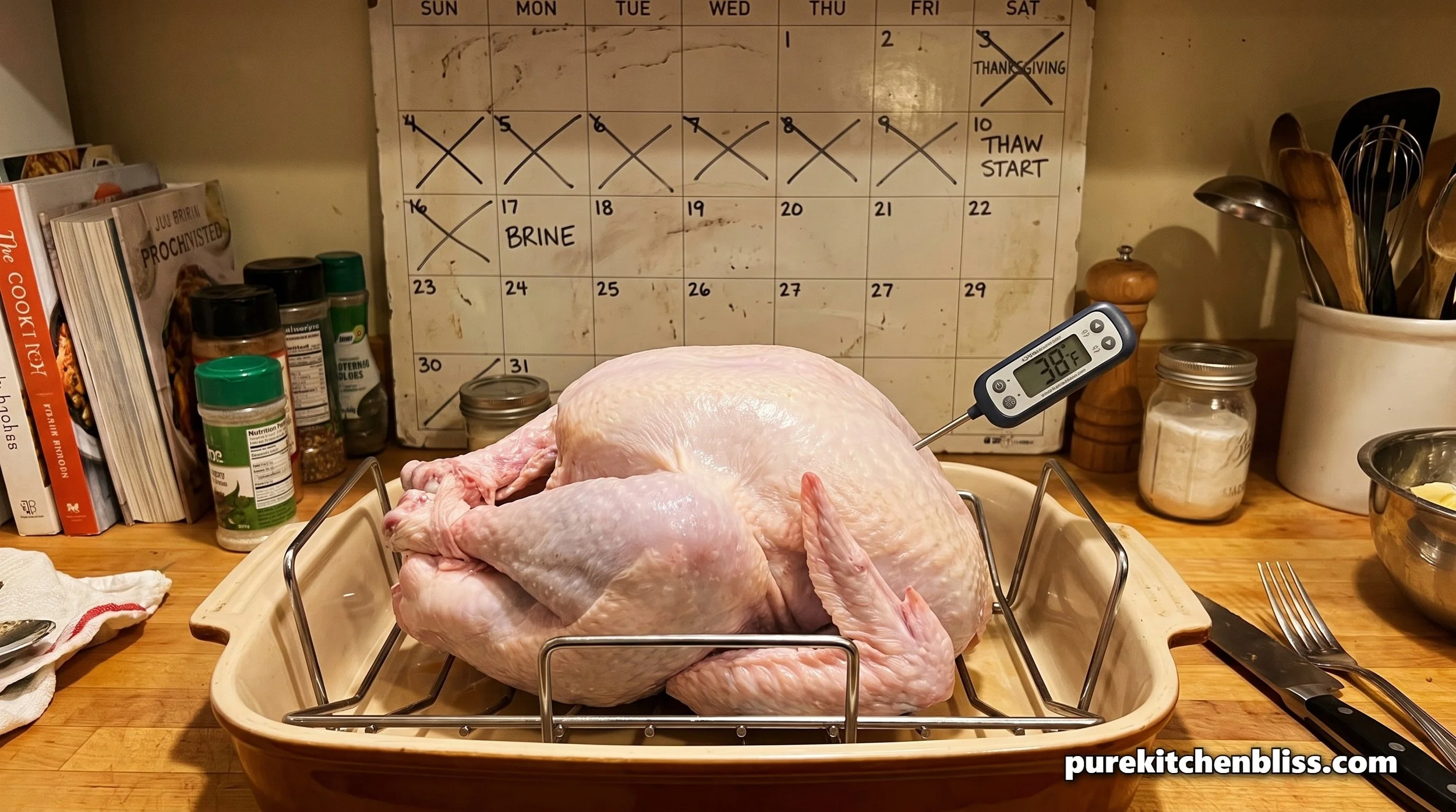
The thawing math, and why it starts earlier than people think
A frozen turkey needs roughly 24 hours of refrigerator thawing time for every 4 to 5 pounds, which means a 16 to 20 pound bird, a common size for a mid-sized family gathering, needs a full 4 to 5 days in the fridge before it's fully thawed. Counting backward from a Thursday dinner, that means the turkey needs to come out of the freezer and into the refrigerator no later than the weekend before, not Tuesday or Wednesday of Thanksgiving week, which is when a lot of people realize they've miscounted.
The refrigerator method is the safest option, but it's not the only one if you're short on time. Cold water thawing works at roughly 30 minutes per pound, with the turkey fully submerged in its original wrapper and the water changed every 30 minutes to keep it cold, and a turkey thawed this way needs to be cooked immediately afterward rather than refrigerated again. What doesn't work, ever, is thawing on the counter or in a car trunk, garage, or basement where the temperature isn't controlled. Even if the center of the bird is still frozen, the outer layer sits in the 40 to 140°F danger zone the entire time it's out, which is exactly the range where bacteria multiplies fastest. Once thawed, a turkey is good in the refrigerator for one to two more days before it needs to go in the oven.
Why "juices run clear" doesn't actually tell you anything reliable
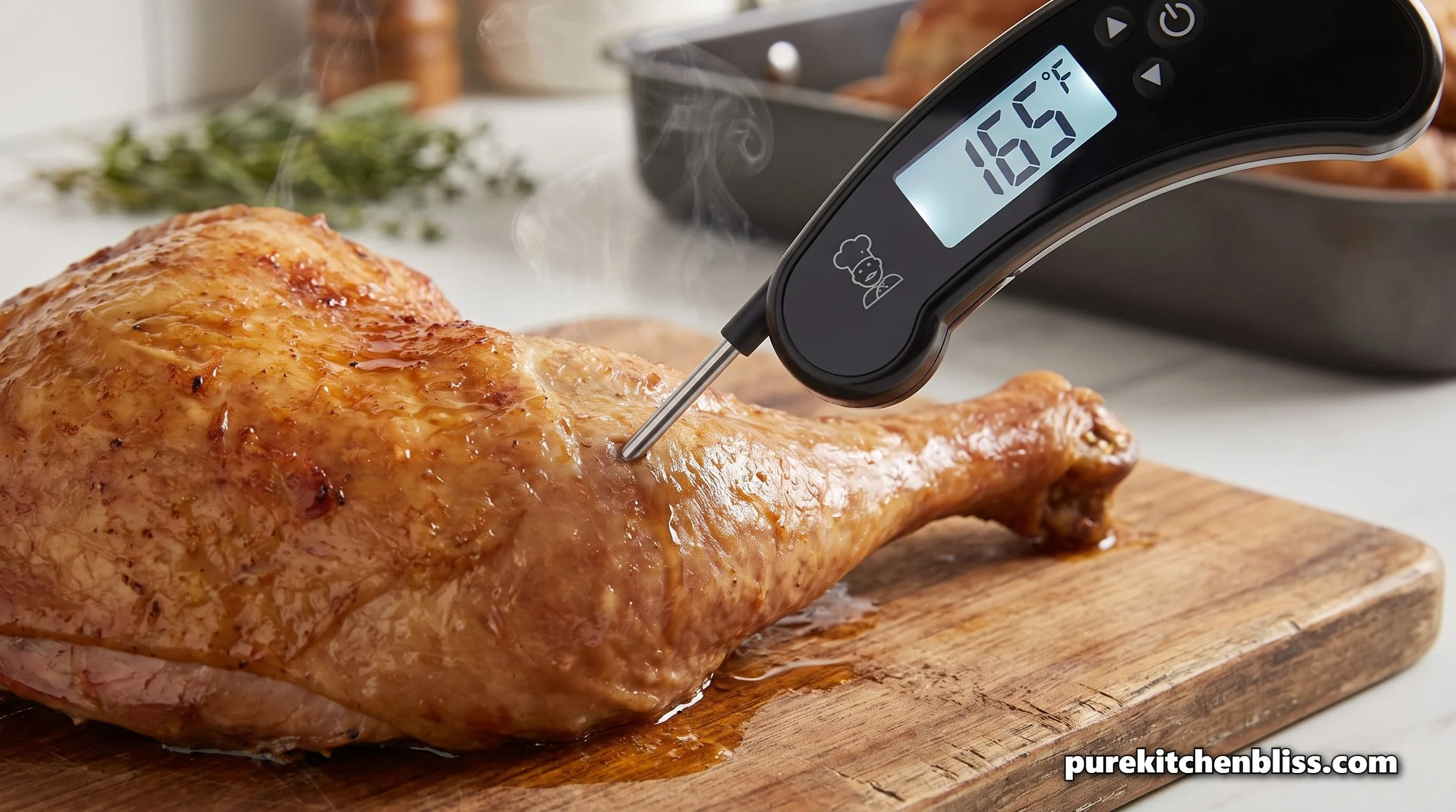
The clear-juices test has been kitchen folklore for generations, and it's genuinely not a reliable safety indicator. Juice color depends on a lot of variables that have nothing to do with internal temperature, including the turkey's age, diet, and even the color of its bones, and plenty of fully safe turkeys still run slightly pink at the joint even at a safe temperature. The only method that actually confirms doneness is a food thermometer, inserted into the thickest part of the innermost thigh, the innermost wing, and the thickest part of the breast, avoiding contact with bone, which reads artificially high and gives a false sense of doneness.
The target is 165°F in all three of those spots, not just one. A breast that reads 165°F while the thigh is still at 155°F isn't done, dark meat and white meat cook at different rates, and checking only the easiest spot to reach is how people end up serving undercooked meat despite doing everything else right.
The stuffing problem most people don't think about
Stuffing the bird is a tradition in a lot of families, but the USDA specifically doesn't recommend it, and the reasoning is worth understanding rather than just following blindly. Stuffing packed inside a turkey cavity cooks more slowly than the turkey itself, since it's insulated by the meat around it, which means the turkey can hit a safe temperature well before the stuffing does. If you pull the bird out based on the turkey's temperature alone, the stuffing inside can still be sitting in unsafe territory. Cooking stuffing separately in its own dish solves this entirely, it cooks evenly, reaches temperature faster, and never depends on the turkey's timing to also be safe.
If stuffing the bird is non-negotiable for your family, a few rules matter more than usual. Never stuff the turkey the night before and refrigerate it that way, bacteria has too much time to multiply inside the stuffing while it sits. Keep wet and dry stuffing ingredients chilled and separate until just before you're ready to fill the cavity, mix them right before stuffing, fill loosely rather than packed tight, and cook immediately. The center of the stuffing itself needs to reach 165°F, checked with a thermometer just like the turkey, not assumed based on how long it's been in the oven.
Roasting time by weight, and the oven temperature that actually matters
Set the oven to at least 325°F, lower temperatures extend cooking time enough that the turkey spends longer in a range where the math around food safety gets less forgiving. For an unstuffed turkey at 325°F, a 12 to 14 pound bird runs roughly 3 to 3¾ hours, while a larger 20 to 24 pound turkey takes closer to 4½ to 5 hours. Add 15 to 30 minutes to those times if you're cooking a stuffed bird, since the added mass slows the whole roast down.
These numbers are estimates, not guarantees, oven calibration, how often the door gets opened, and altitude all shift actual cooking time in either direction. Treat the chart as a planning tool for when to start, not as a substitute for the thermometer check that actually confirms doneness.
| Turkey weight | Refrigerator thaw time | Unstuffed roast time (325°F) |
|---|---|---|
| 4-12 lbs | 1-3 days | ~2¼ - 3 hours |
| 12-14 lbs | 3 days | 3 - 3¾ hours |
| 16-20 lbs | 4-5 days | 4 - 4¼ hours |
| 20-24 lbs | 5 days | 4½ - 5 hours |
The two-hour rule that applies to the whole meal, not just the turkey
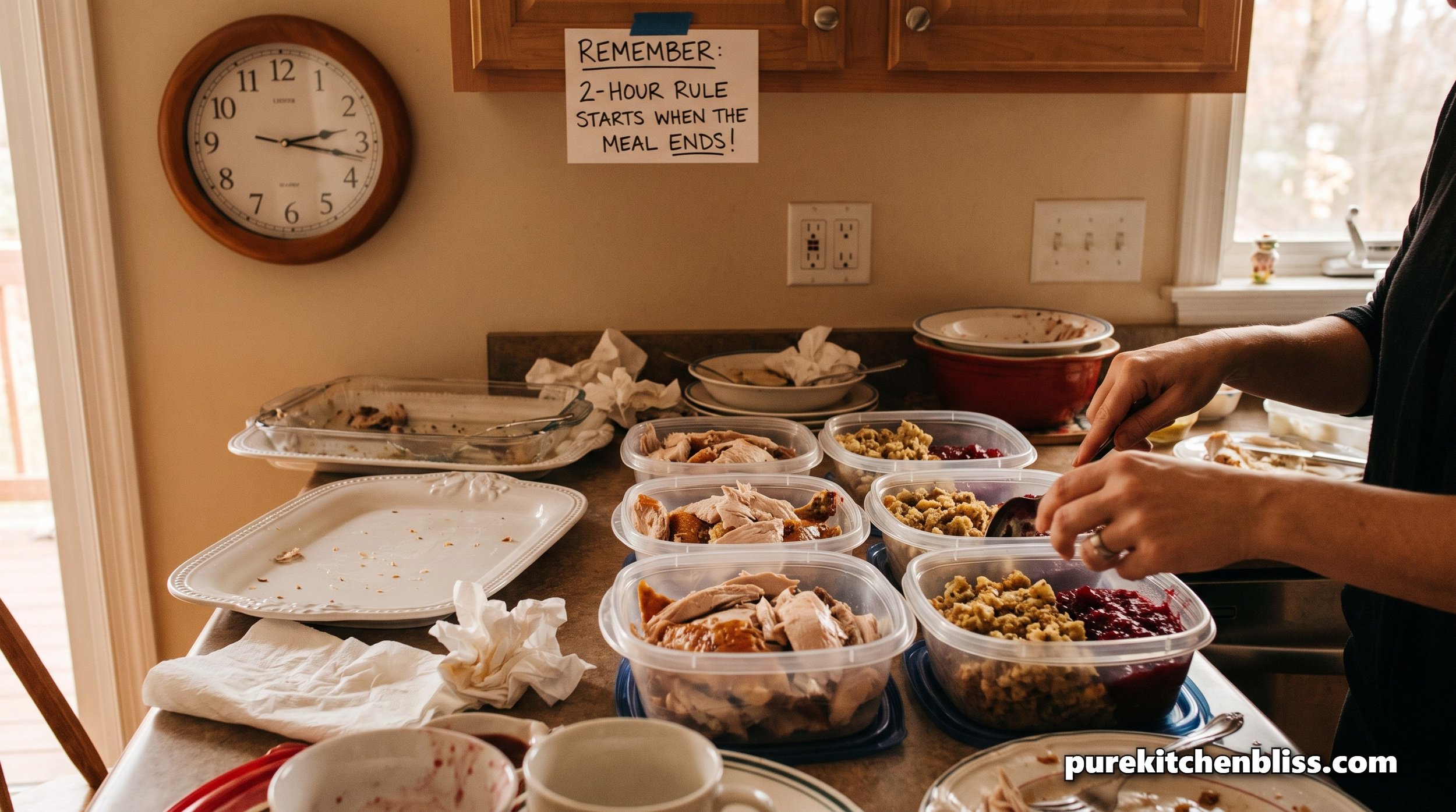
Once the turkey and sides come off the heat, the same danger zone math from the thawing section applies again. Food left sitting at room temperature between 40 and 140°F for more than two hours, or one hour if the room is above 90°F, needs to be discarded rather than served or saved. In practice, this means getting leftovers into the refrigerator within two hours of the meal ending, not after dessert, gift exchanges, and cleanup, which can easily eat past that window at a big family gathering.
If you're also running a hot beverage station for guests through the afternoon, the same hold-temperature logic applies there too, we cover the specifics of holding food and drinks safely for hours in our fall cider station guide, which is really the same underlying principle applied to a different dish.
Clearing fridge space before the turkey even arrives
A 20-pound turkey, even before cooking, takes up a genuinely large amount of refrigerator real estate during its multi-day thaw, and a fridge already packed with pre-Thanksgiving groceries doesn't always have room for it. Clearing a dedicated, low shelf for the thawing turkey a few days ahead, in a container to catch any drips so raw juices don't contaminate anything else, avoids the last-minute scramble of trying to rearrange a full fridge the same day the turkey needs to go in. If your fridge organization needs a reset before the holiday rush hits, our fridge and pantry organization guide covers the same zone-based thinking applied here.
What I actually use to get this right every year
A reliable instant-read meat thermometer is the single most important tool on this list, since every safety number in this guide depends on an accurate reading rather than a guess. A sturdy roasting rack and pan keeps the bird elevated for more even cooking and makes it easier to get an accurate thermometer read without hitting the pan bottom. For anyone who wants a hands-off option through a long roast, a leave-in probe thermometer with an alarm tracks temperature continuously and alerts you the moment the thigh hits 165°F, rather than requiring repeated oven door openings to check manually.
What this actually comes down to
Two numbers carry most of the actual safety risk in a Thanksgiving turkey, thaw time based on weight, and internal temperature checked with a thermometer in three separate spots rather than trusted by color or time alone. Count backward from your serving day to figure out when thawing needs to start, cook stuffing separately if you want the safest version of the tradition, and get everything into the fridge within two hours once the meal wraps. None of it requires special skill, just planning around the actual numbers instead of instinct.