Whenever a client walks into a freshly finished kitchen remodel, the first thing they usually do is take a deep breath and say, "Wow, love that new kitchen smell!"
As a carpenter and a business owner, I hate to ruin the moment, but that "new kitchen smell" is actually a chemical soup. It’s the sound of millions of microscopic VOCs (Volatile Organic Compounds) escaping from the glues, binders, and sealants used to build the cabinets.
In a house with four kids, indoor air quality isn't some abstract environmental concept, it’s a direct safety metric. If we are spending time crafting a kitchen sanctuary, we can’t build it on top of materials that actively emit toxic fumes into our homes.
For decades, custom builders have treated structural plywood as the undisputed champion of cabinet construction. But in 2026, a massive shift is happening. A new competitor called Wheatstraw Agrifiber is challenging the throne, promising to eliminate toxic off-gassing entirely. Let’s look behind the finished veneer and break down the raw science of what you’re putting in your home.
1. The Hidden Enemy: Urea-Formaldehyde 🧪
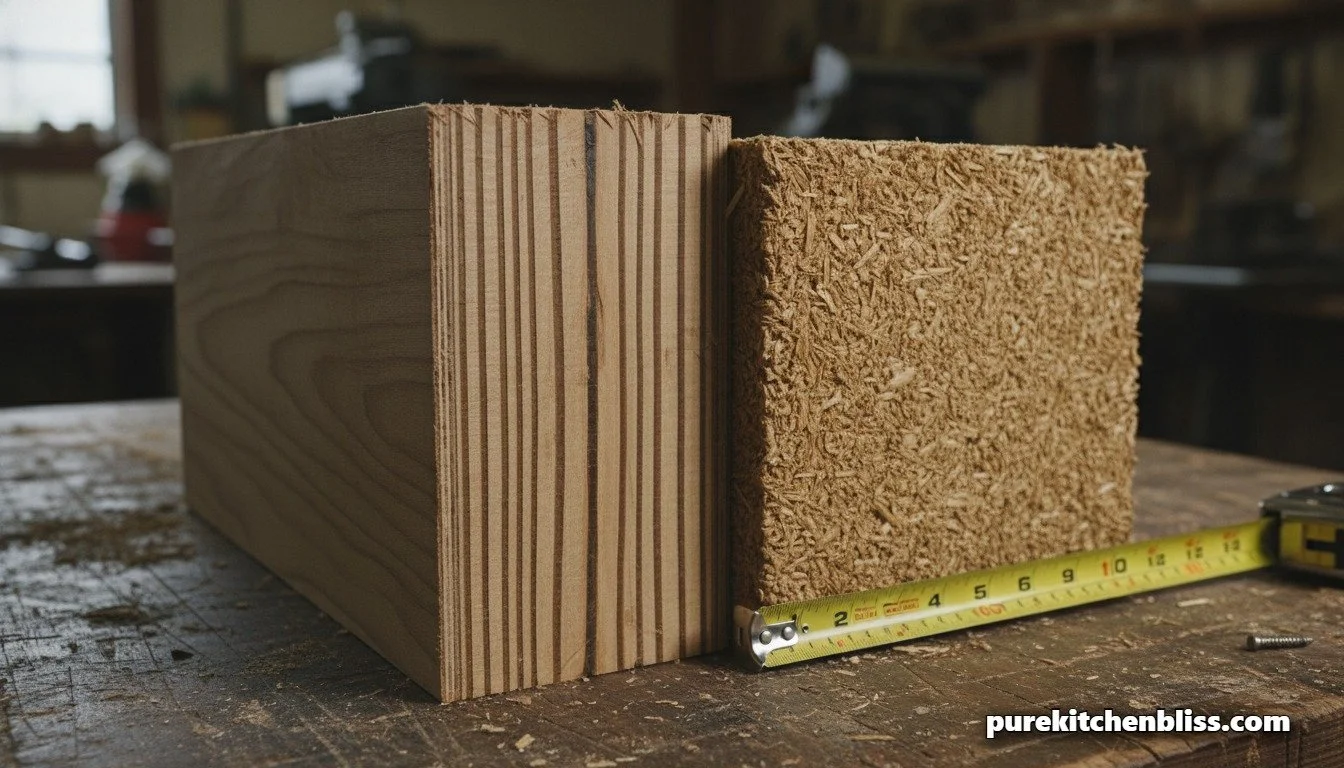
To understand why standard cabinets are problematic, you have to look at how a basic cabinet box is engineered. Standard particleboard and generic MDF (Medium-Density Fiberboard) are essentially sawdust mixed with glue and pressed into sheets.
The Glues: Historically, the cheapest, strongest way to bind those wood fibers together was using Urea-Formaldehyde (UF) resins.
The Off-Gassing: Formaldehyde is a known carcinogen. A newly installed kitchen using big-box particleboard boxes can steadily leak these microscopic gasses into your home for up to five years, triggering asthma and allergies in kids.
The Shop Reality: In my shop, I won't let my crew cut standard cheap MDF without heavy industrial respirators. If it isn't safe for my team to cut, it shouldn't be sitting in your home next to your fresh food.
2. Plywood: The Traditional Heavyweight 🏗️
For years, the professional answer to the cheap particleboard problem has been cabinet-grade plywood.
The Strength: Plywood is made by layering thin sheets of solid wood grain at alternating 90-degree angles. It holds screws beautifully, resists sagging under heavy stone countertops, and has a much higher natural moisture tolerance than generic MDF.
The Catch: While plywood contains far less glue than pressed fiberboard, the glue still matters. Unless you explicitly spec NAF (No Added Formaldehyde) plywood that uses soy-based or water-reducible binders, you are still bringing trace chemicals into your kitchen footprint.
3. Comparison: Structural Plywood vs. 2026 Wheatstraw Agrifiber
| Performance Metric | Standard NAF Plywood | 2026 Wheatstraw Fiberboard | Builder’s Choice |
|---|---|---|---|
| Toxicity / Emissions | Low (Trace elements) | Zero (100% Formaldehyde-Free) | Wheatstraw Winner |
| Moisture Resistance | High (Delamination risk) | Extreme (Natural silica wax) | Tie |
| Weight Capacity | Maximum structural rigidity | High (12% lighter than wood MDF) | Plywood Winner |
4. Enter Wheatstraw: The Zero-Emission Revolution 🌾
In 2026, advanced manufacturers (like Great Plains MDF) are harvesting an agricultural waste product that farmers usually burn: wheat straw.
The Engineering: By taking the leftover stalks of wheat, refining them into fine agricultural fibers, and compressing them, they create an incredibly dense panel that behaves just like a high-performance MDF.
The Glue Upgrade: Because wheat stalks naturally contain a high level of silica (nature's waterproof barrier), these boards don't use formaldehyde glues. They are bonded using polyurethane-based binders that are 100% formaldehyde-free and contain non-detectable VOC levels.
The Carpenter’s Verdict: Wheatstraw panels are about 12% to 14% lighter than traditional wood-based fiberboards, making them easier to hang on site. They don't have grain direction, meaning they won't warp or twist when exposed to the high humidity of a busy kitchen or a hidden working scullery.
5. How to Spec a Safe Kitchen: The Builder's Checklist 📋
If you are planning a renovation and want to guarantee a clean-air environment for your family, do not let your contractor pick whatever is sitting on the warehouse floor. Use this checklist:
The Core Spec: Request Formaldehyde-Free Agrifiber or NAF-certified core plywood for all cabinet carcass boxes.
The Finish Spec: Ensure the outer doors are painted with low-VOC waterborne polyurethanes rather than traditional oil-based solvent lacquers.
The Hardware Check: Pair your clean boxes with high-performance internal hardware, like the silent, fluid-dampened hinges we discussed in our guide to acoustic architecture.
When you build with sustainable, toxin-free infrastructure, your kitchen stops being a source of chemical stress and becomes what it was always meant to be: a healthy, thriving sanctuary for your family to grow up in.
Next Up: Want to keep your clean-air kitchen entirely organized? Check out our The Vertical Kitchen: Why I’m Moving My Spices Out of the Drawer and Onto the Fridge!.