Should You Eat Off the Kitchen Counter? The Professional Verdict
In the "Beautiful Chaos" of a busy home, the kitchen island is the ultimate multi-tool. It’s a homework station, a prep zone, and a buffet line. However, just because a surface is clean to the eye doesn't mean it’s safe for your food.
In my years of residential construction and home maintenance, I’ve seen what goes into (and onto) kitchen counters. Before you place that slice of pizza directly on the stone, we need to talk about Material Porosity, Chemical Residuals, and the "Bio-Load" of a family home.

1. The Porosity Problem (The "Sponge" Effect)
Most people view stone counters as solid, impenetrable blocks. In reality, natural stones like granite, marble, and limestone are full of microscopic pores.
The Risk: If your counter isn't perfectly sealed, those pores act like tiny storage tanks for raw chicken juice, old milk, and cleaning fluids. Even if you wipe the surface, the bacteria inside the stone can remain.
The "Pure" Rule: Unless you have a non-porous material like high-quality Quartz or Stainless Steel, the counter should be viewed as a "Prep Zone," not a "Plate."
BUILDER TIP: PROTECTING THE BONES To ensure your stone isn't absorbing bacteria, you must maintain its structural seal. A "thirsty" counter is a dangerous counter. Read More: [How Often Should You Clean Your Countertops? The Professional Maintenance Schedule]
2. Chemical Residuals: The "Invisible Film"
Even if you are a "Compulsive Wiper," the very thing you use to clean could make the surface unsafe for food contact.
Synthetic Cleaners: Most grocery-store "All-Purpose" cleaners leave behind surfactants and synthetic fragrances. When you place warm food on the counter, the heat can cause these chemicals to transfer into your meal.
The Non-Toxic Solution: This is why we advocate for a DIY, bio-available approach. If you are going to eat near your counters, you want the residue to be as simple as water and plant-based soap.
CURATOR’S PICK: THE NON-TOXIC DEGREASER If you want a surface that is truly safe for your family, you need a cleaner that breaks down grease without leaving a laboratory behind. Read More: The Best Non-Toxic Kitchen Degreaser: A Professional’s DIY Recipe
3. Cross-Contamination in the "Beautiful Chaos"
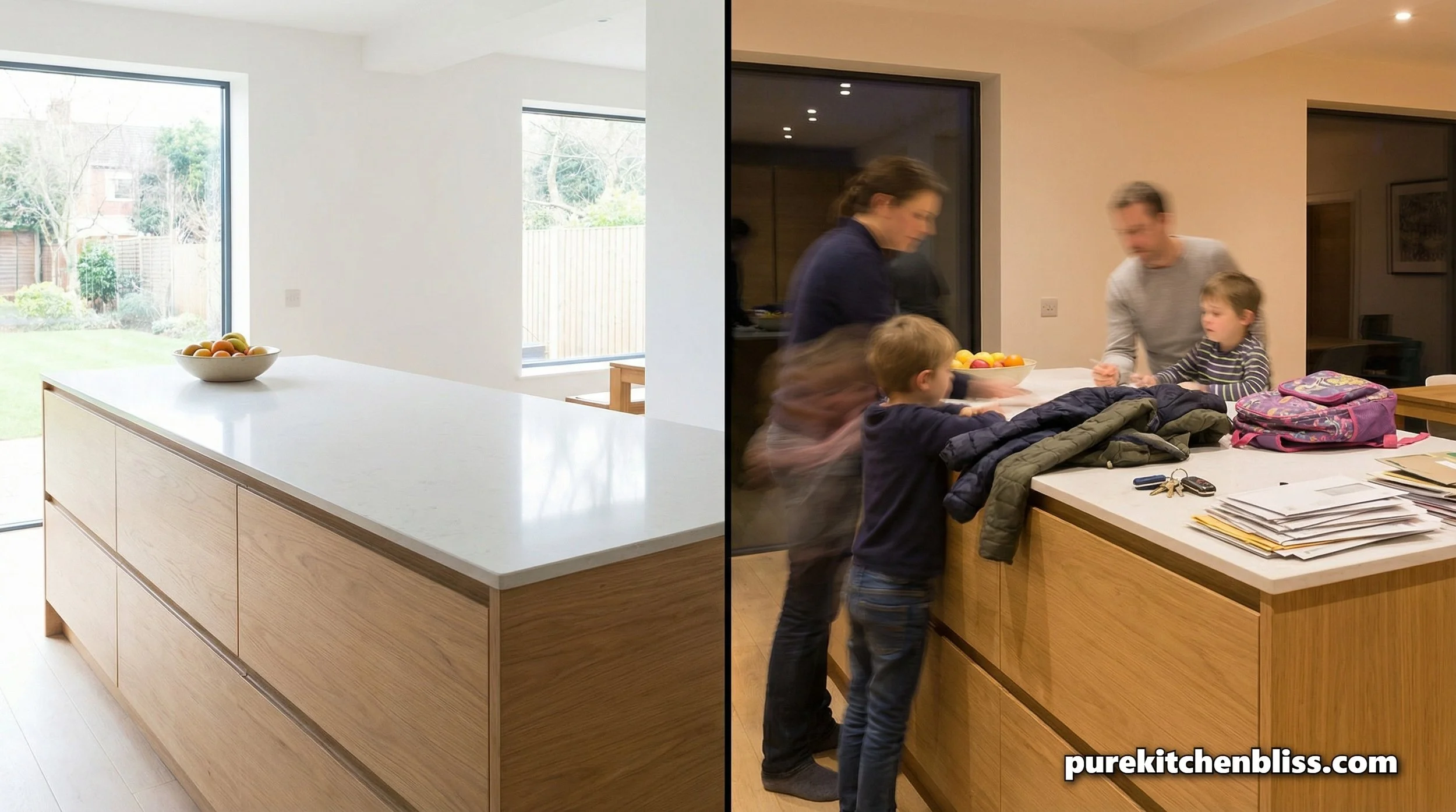
In a house with four kids, the kitchen counter is a "High-Traffic Job Site."
The Reality Check: Think about what has touched that counter in the last four hours. A school backpack (which sat on the bus floor), a bag of groceries (which sat in a shopping cart), or perhaps the family dog leaning up against the edge.
The Bio-Load: Even the most diligent "Sunday Reset" can't account for the microscopic trail left by the daily rhythm of a family.
How to Make Your Counters "Food-Safe"
If you love the look of eating off the island, follow this "Pure Kitchen" Protocol:
Use a Physical Barrier: Utilize large, wooden "Charcuterie" style boards. It gives you the aesthetic of eating off the counter while providing a controlled, food-safe surface that can be properly sanitized.
The "Squeaky Clean" Test: If you run your hand across the counter and it feels "tacky" or leaves a smudge, there is a grease-film present. Do not put food on it.
The Bio-Filter: Keep the air around your eating area clean to prevent falling dust from contaminating your food.
BUILDER TIP: BIOLOGICAL PURITY Plants don't just look good; they settle dust and scrub toxins from the air around your dining zone. Read More: 7 Unkillable Plants That Thrive in Your Busy Kitchen
Conclusion: Use the Counter, Respect the Plate
At the end of the day, your kitchen counter is a piece of Home Infrastructure. It’s built to work. While a high-quality, non-porous surface that has been cleaned with our Non-Toxic Degreaser is technically "safe," the best practice for a Sustainable Sanctuary is to use a plate or a board.
Respect the "bones" of your kitchen, and they will serve your family for a lifetime.