How to Grow Basil Indoors: The Expert Care Guide
Transparency Note: We independently select these products based on research and user reviews. If you buy something through our links, we may earn a commission.
If you love fresh pesto, caprese salads, or a simple garnish for your pasta, basil is the one herb you absolutely need in your kitchen. But basil is also notoriously difficult to keep alive indoors. It isn't a "set it and forget it" plant; it is a high demand biological system that requires specific environmental inputs to thrive.
When you get it right, a single basil plant can provide you with leaves for months. When you get it wrong, it grows tall, spindly, and dies within weeks. Here is how to build a high-performance basil station on your kitchen counter.
1. The Infrastructure: Light and Drainage
Basil is a tropical plant, it demands heat and intense light. If you treat it like a low-light houseplant, it will fail.
The Light Protocol: Basil requires at least 6 to 8 hours of direct, unfiltered sun. If your kitchen window faces North or is shadowed by trees, "natural light" won't be enough. If the plant starts growing thin, pale stems, it is "stretching" for light (a process called etiolation). At this point, your only solution is to install a small, full-spectrum LED grow light. This provides the specific wavelengths needed to maintain the leaf-to-stem energy balance.
Drainage is Non-Negotiable: Basil roots need to breathe. If your pot has no hole at the bottom, water will collect, become stagnant, and suffocate the roots (root rot). If you have a decorative pot you love, keep the basil in its original plastic nursery pot and set that inside the decorative one. This allows you to remove it for watering, ensuring excess moisture drains away completely.
2. Soil Chemistry: The pH Factor
Most indoor herb gardeners ignore soil chemistry, but it is the "operating system" of your plant. Basil thrives in soil with a pH between 6.0 and 6.5. If your soil is too acidic (common in cheap peat-based potting mixes) or too alkaline, the plant literally cannot absorb the nutrients you’re feeding it, regardless of how much fertilizer you apply.
When buying potting mix, look for one that is specifically formulated for herbs or vegetables. These are usually "buffered" to maintain that neutral pH range, ensuring the nitrogen and phosphorus are "bio-available" to the plant roots.
3. The Mechanics of Pruning: The "Pinch" Explained
Most people treat basil like a "pick-and-go" herb, snapping off big leaves from the bottom. This is the fastest way to ruin your plant. When you pull a big leaf off the bottom, the plant doesn't know how to compensate, and it continues to grow into a tall, single-stem "beanstalk" that is prone to snapping under its own weight.
You need to prune for branching, not just for eating.
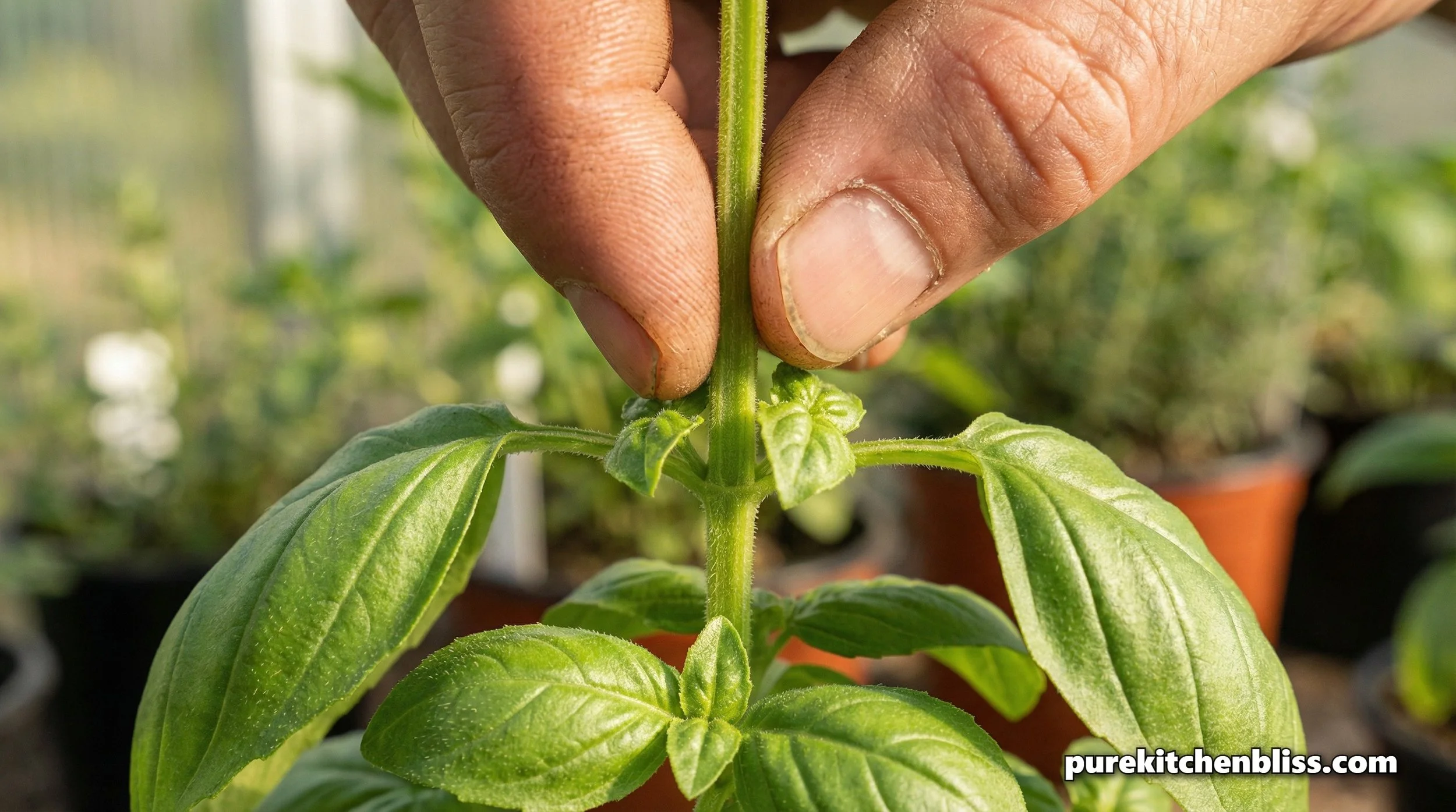
The Node: Look at your stem. You will see a pair of large leaves, and right where they meet the stem, there is usually a tiny pair of smaller, "baby" leaves sprouting. That junction is the node.
The Action: Snip (or pinch) the main stem just above those two small leaves.
The Result: The plant is now forced to stop growing vertically and divert all its energy into those two tiny leaves, which will grow into two new, full-sized stems.
By repeating this "pinch" every time you harvest, you essentially double your plant’s growing points every two weeks. This is how you transform a single, weak stem into a massive, bushy powerhouse.
| Problem | Root Cause | The Expert Fix |
|---|---|---|
| Yellowing Bottom Leaves | Soil saturation | Stop watering; ensure airflow; check drainage. |
| Tall, "Leggy" Stems | Light starvation | Use full-spectrum LED grow light. |
| Sudden Wilting | Root zone dehydration | Deep soak; verify pot depth. |
4. Water Management: Stop the "Schedule"
One of the most dangerous things you can do to an indoor herb is water it on a "schedule." Kitchen environments are dynamic, temperature and humidity fluctuate daily.
Instead, use the Touch Test. Stick your finger into the soil up to the first knuckle. If it’s damp, leave the plant alone. If it’s dry, give it a thorough, deep watering until water runs out the bottom drainage hole. This prevents the "drown and dehydrate" cycle that prevents indoor basil from developing strong, resilient roots.
5. The Variety Audit: Genovese vs. Thai vs. Greek
Not all basil is the same. Understanding the variety helps you tailor your care:
Genovese (Sweet Basil): The classic, large-leaf variety. High water needs, very prone to wilting. Best for pesto.
Thai Basil: Smaller, darker leaves with purple stems. It is much more tolerant of heat and dry conditions than Genovese. If your kitchen is hot, start here.
Greek Basil (Dwarf): Tiny leaves that grow in a perfectly round, compact ball. This variety naturally stays "bushy" without requiring as much pinching.
6. Troubleshooting the "Grocery Store" Basil
If you bought a "live" basil plant from the grocery store, you might have noticed it dies within a week. That is because the grocery store "live" plants aren't actually single plants, they are dozens of tiny seeds jammed into one small container to make it look "full" for the shelf. They are starving for root space and competing for nitrogen.
The Pro Move: If you want a grocery store plant to survive, you need to "split" it immediately. Carefully remove the root ball, gently tease the individual basil plants apart (do not worry about minor root tearing), and replant them into 3–4 separate pots. It feels like surgery, but it’s the only way to give the roots enough nitrogen and oxygen to survive long-term.
7. Ready to Start?
Stop wasting money on plastic containers of herbs that rot in your fridge. Start your own high-yield basil patch on your windowsill and enjoy the flavor of fresh, homegrown herbs all year long.
Different Types of Basil